By Jung Da-min
Voters will cast ballots at 14,330 polling stations, Wednesday, to elect 300 lawmakers through two votes, one for 253 single-member constituencies and the other for the remaining 47 proportional representation seats. Voting will be held from 6 a.m. to 6 p.m.
Attention is focused on whether the ruling Democratic Party of Korea (DPK) can ride on its high approval ratings ― seen in a series of surveys ― to secure a majority of seats, or the main opposition United Future Party (UFP) can pull off an unexpected result to win a large enough number of seats to hold the ruling bloc in check, something it claims is necessary.
Dominant issues are how the COVID-19 situation will affect voter turnout, and who swing voters and “shy” supporters of the conservative or liberal camps will cast their ballots for.
While early voting conducted between Friday and Saturday recorded its highest-ever turnout since its introduction in 2014 at 26.69 percent, analysts are focusing on whether the overall turnout will also be the highest for a general election.
According to a survey of eligible voters conducted April 4 and 5 by Gallup Korea at the request of the National Election Commission (NEC), 79 percent of respondents said they would “definitely vote” in the 21st General Election, up 12.8 percentage points from the 66.6 percent in a poll for the 20th General Election four years ago. Combined with the 15.1 percent who said they would “vote if possible,” 94.1 percent of respondents said they were willing to vote this year. The total number of eligible voters is 43.9 million.
Some political watchers, however, say the high turnout in early voting may not necessarily lead to a high overall turnout as it could be that many voted early to reduce their possible exposure to COVID-19 at crowded polling stations. 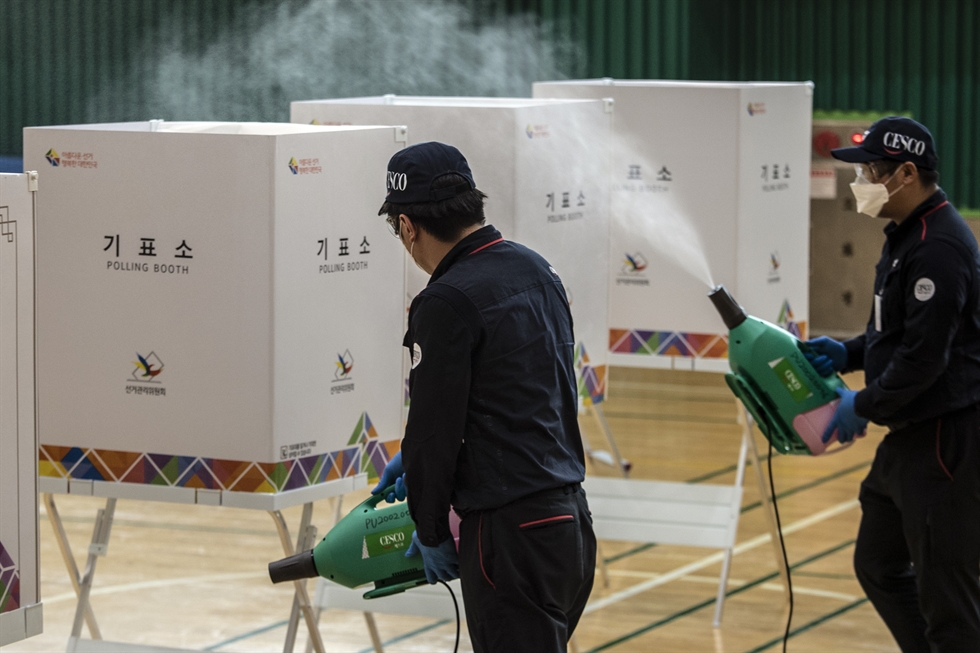
The NEC has introduced special measures for each polling station to prevent the spread of the coronavirus, such as temperature checks, providing disposable plastic gloves, and operating a separate booth for those with high temperatures or respiratory symptoms. Those under self-quarantine without suspected symptoms of COVID-19 are allowed to cast their ballots at polling stations after 6 p.m. on the election day, separately from other voters.
Both the DPK and UFP claim that a high turnout will be in their favor. The DPK said people will support it to stabilize state affairs through cooperation between the government and the National Assembly, while the UFP said people will want to judge the Moon Jae-in government’s “failure in its income-led growth policy” and want the main opposition party to check the ruling bloc.
The final result of the election will come late, around Thursday afternoon according to the NEC, as the ballot paper for the proportional representation vote is too long and won’t fit in ballot counting machines. Accordingly, election officials will have to count the votes by hand.
The long paper is due to the participation of 35 “parties,” a result of a new electoral system aimed to give more seats to minor parties. This led to the creation of many small parties, while the DPK and UFP created “satellite parties” to seize more of the proportional representation seats.