 |
| (Yonhap) |
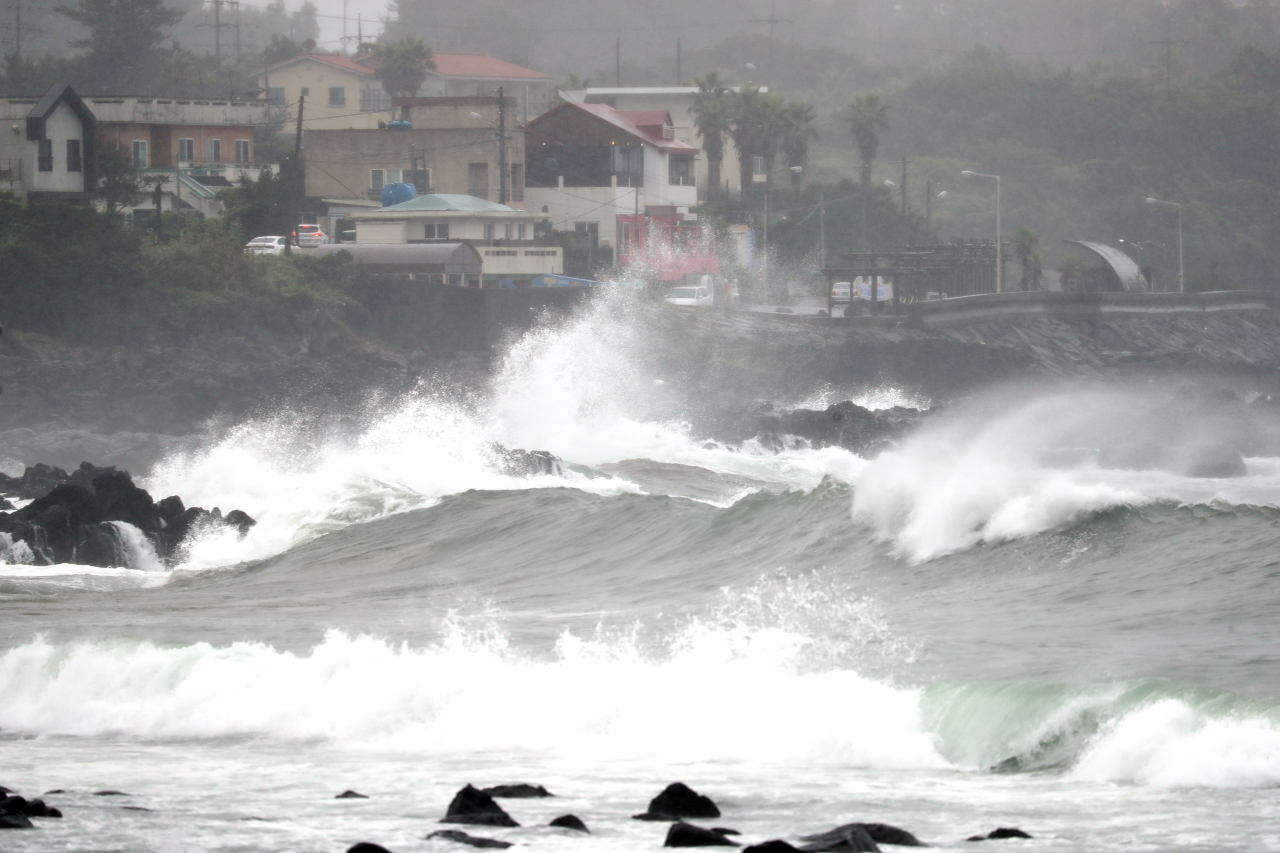
South Korea was on alert over Typhoon Bavi as the season’s eighth typhoon, one of this year’s most powerful storms, tore through the resort island of Jeju and other southern regions on Wednesday.
The typhoon reached waters near Mokpo, 410 kilometers south of Seoul in South Jeolla Province, at 6 p.m., and was moving north at 30 kilometers per hour, with the maximum wind speed of 43 meters per second.
The KMA forecast the typhoon to approach Seoul at around 5 a.m. Thursday. It was then expected to move upward to Hwanghae Province in North Korea.
As of 11 p.m., a typhoon advisory will take effect in Seoul.
As of 7 p.m., 15 municipalities in South Chungcheong Province were placed under a typhoon advisory. They were later joined by 23 municipalities in Gyeonggi Province and over two dozen areas in South Jeolla and North Jeolla Provinces. Other cities and provinces are operating on a heightened disaster alert.
The weather agency projected the tropical storm to bring strong gusts that could break the record set by Typhoon Maemi in 2003.
Maemi logged a maximum wind speed of 60 mps on Sept. 12, 2003. A wind speed of 35 mps can derail trains, and if it exceeds 40 mps, the wind can even topple cars and huge rocks.
“Bavi is forecast to break a record among typhoons that passed through the Yellow Sea,” said Woo Jin-kyu, a researcher at the weather agency, “Wind speed is likely to depend on the speed and strength of the typhoon but strong gusts are expected.”
Rain was forecast for most parts of the country until Friday, with heavy rains of more than 150 mm expected in South Jeolla Province, South Gyeongsang Province and Jeju. More than 250 mm of rain was forecast for areas near Mount Jiri.
Strong gusts and waves were especially expected in the country’s southern and western coastal areas, as the typhoon was expected pass through the Yellow Sea.
Flights and ferries were suspended across the country as the typhoon neared the country.
All 483 flights that were scheduled to arrive or depart from Jeju International Airport on Wednesday have been called off, according to the Jeju branch of Korea Airports Corp.
“Jeju International Airport is expected to be busy Thursday. Please check your flight information in advance before visiting the airport,” a Jeju airport official said.
Fifteen ferries leaving from Jeju have also been canceled, with more than 1,900 ships docked at the island’s ports ahead of the tropical storm.
Trekking routes at Mount Halla, the island’s highest peak, have also been restricted.
Scores of damage were reported on the southern island, with the strong winds destroying signs and fences. Some roads were swamped due to heavy rain, and power disruption was reported at some houses.
South Jeolla Province also suffered effects of the typhoon, with nearly 40 reports of trees and storefront signs falling off.
Flights have also been canceled at airports across the nation in Seoul, Gimhae, Ulsan, Yeosu, Muan and Gwangju.
More than 50 flights scheduled to depart from Gimpo International Airport and arrive at Gimhae and Jeju have been canceled, according to the Korea Airports Corp.
Train services have also been disrupted, especially in South Jeolla Province in the southwestern part of the country.
Some outdoor screening centers in the capital that are set up inside tents and container boxes are expected to be closed from 9 a.m. to 1 p.m. on Thursday.
The environment ministry has been controlling water release volume at dams to prevent floods, while trekking routes and camping sites at 21 national parks have been restricted.
Some 130 schools in Jeju and South Jeolla Province shifted to remote learning or suspended classes as a precautionary measure.
“Please prepare thoroughly as the strong winds can affect outdoor screening centers, construction sites and power facilities. This could prompt secondary damage as well as trigger losses at farms,” the KMA said. (Yonhap)