 |
| (Yonhap) |
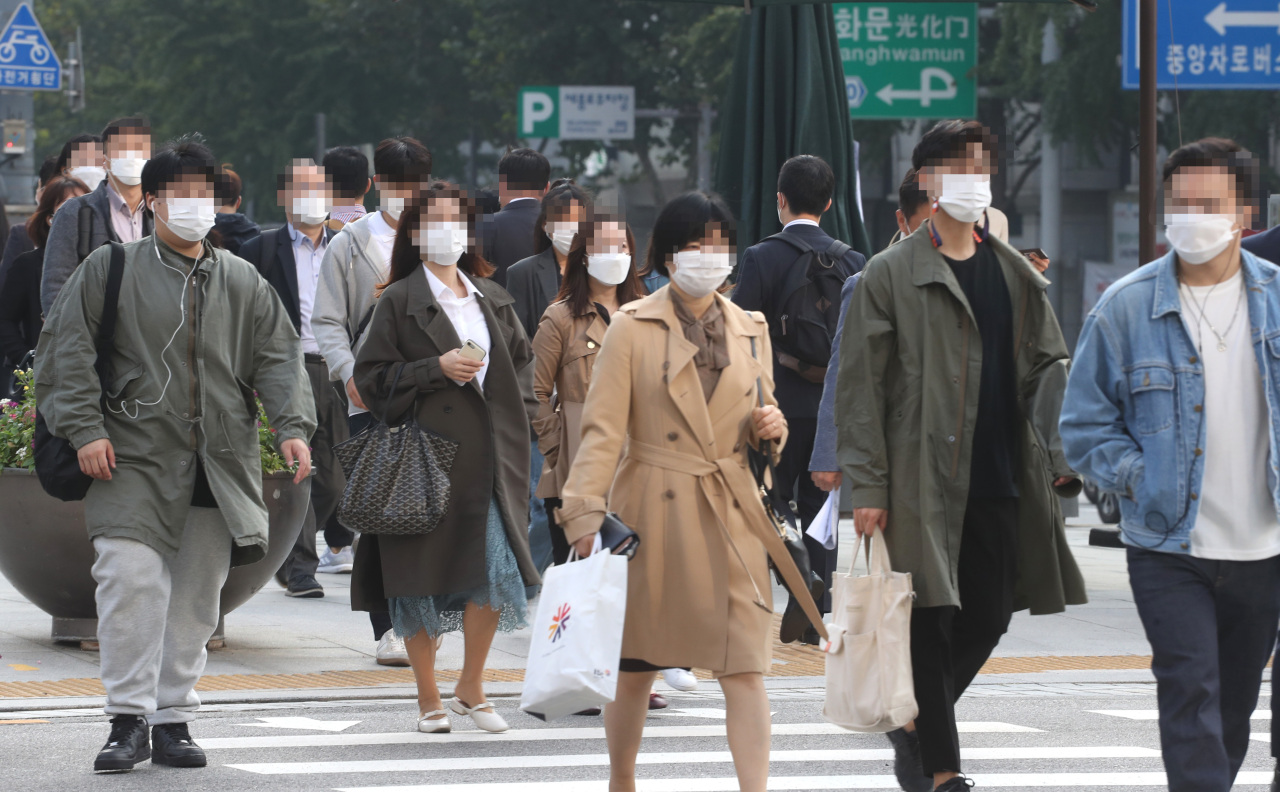
Mask-wearing has become mandatory in South Korea on all forms of public transportations, in medical facilities and other designated public spaces as of Tuesday, but not all types of face coverings are deemed acceptable.
Considered suitable are the government-certified medical masks such as KF-94, KF-80 or KF-AD as well as cotton masks and ordinary, disposable hygiene masks, if worn properly covering both the nose and mouth.
Masks with valves and made out of mesh are categorized as improper because they do not effectively block the spread or inhalation of respiratory droplets that may carry the new coronavirus, as evidenced in a study published Tuesday.
Those caught wearing improper face masks or not wearing masks at all in designated public are subject to fines of up to 100,000 won after a 30-day grace period that started Tuesday.
According to the Seoul Research Institute of Public Health and Environment, face masks made from mesh were only 17 percent effective in blocking respiratory droplets. While mesh masks may be more comfortable when it comes to breathing, they cannot be expected to help prevent spread of COVID-19, it said.
The same study found KF-AD masks to be up to 80 percent effective in blocking respiratory droplets and are much more comfortable in than medical masks with KF-80 and KF-94 designations.
“But it would be better to wear KF-80 and KF-94 face masks when visiting hospitals, highly-populated and risky places or while sick to prevent catching COVID-19,” said Shin Yong-seung, head of the research institute in a statement.
Masks with values are also banned as exhaling through the attached valve does not help prevent getting the virus from those infected. Scarves and other cloth items are not authorized as face masks.
The mask mandates are for those using public transportation, participating in rallies, visiting medical and care facilities as well as other high-risk facilities including certain types of bars and karaokes, indoor gyms, large cram schools, buffet restaurants and logistics centers.
In the capital region of Seoul, Incheon and Gyeonggi Province, smaller cram schools, amusement parks, large restaurants, study cafes, religious centers, wedding halls and movie theaters have also been added to the list. But those under the age of 14 and those who are unable to wear masks due to medical conditions are exempt from the requirement. The face mask requirement also does not apply when people are eating, swimming or washing their faces.
Operators of the listed facilities as well as demonstration organizers can be fined up to 3 million won for failing to enforce the government requirement.
The scope of public places subject to the face mask requirement could expand depending on the level of social distancing that is imposed. Local governments are allowed to adjust the scope depending on the virus situation in a particular region.
By Ko Jun-tae (ko.juntae@heraldcorp.com)