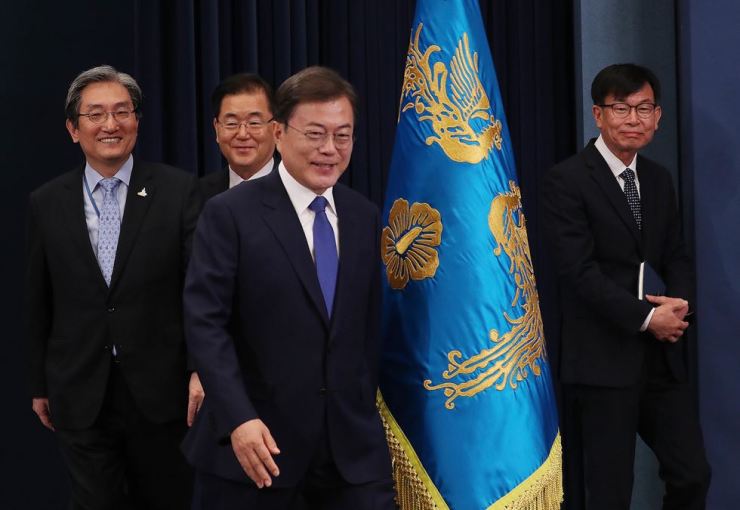
Moon introduces strategies to overcome challenges from COVID-19
By Do Je-hae
President Moon Jae-in said South Korea will take the initiative in the post-pandemic global economy in his economy-centered message, delivered to mark his third year in office during a rare speech at Cheong Wa Dae’s press center, Sunday.
Comparing the current situation to the Great Depression almost a century ago, Moon introduced a range of measures to address the mounting difficulties shouldered by industries and working families and fears of job losses across various sectors in the wake of the pandemic. “It is the economy that matters. This current economic crisis is being compared to the Great Depression 100 years ago,” Moon said. “As even our key industries and flagship businesses, which have remained relatively strong, are facing increasing difficulties, more and more of these businesses are urgently requesting financial support,” Moon said. 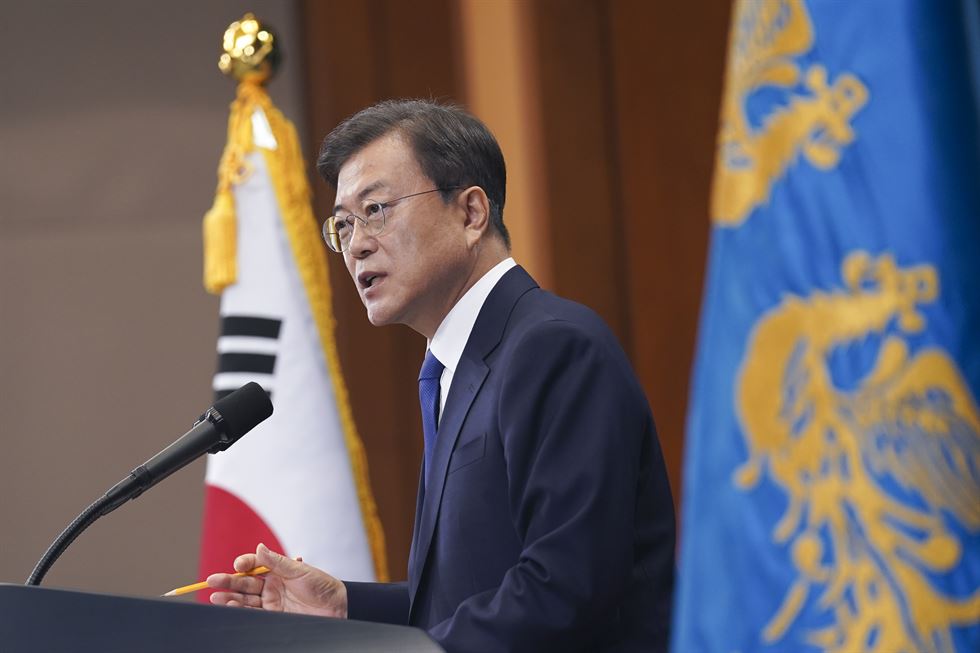
“The employment shock is also growing as time passes. Unemployment fears are spreading beyond self-employed small business owners, non-permanent workers and day laborers to affect almost all employees, including full-time employees and those at mid-market companies and large businesses. This is undeniably an economic wartime situation.”
Job cuts and lack of new hires have emerged as some of the biggest concerns among Korean workers in the post-COVID-19 era. Moon underlined that his government will turn “crisis into opportunity” by creating new jobs in sectors that can thrive in the pandemic era, such as ICT, non-face-to-face medical services, online education and transactions, epidemic prevention and the biotech industry. “We have ample capabilities to lead the digital economy by combining Fourth Industrial Revolution technologies such as artificial intelligence and big data,” Moon said. “We will push ahead with bold strategies to attract high-tech industries and investments from overseas as well as to help Korean companies return from abroad. The Republic of Korea will become a world factory of high-tech industries, thereby changing the global industrial map.”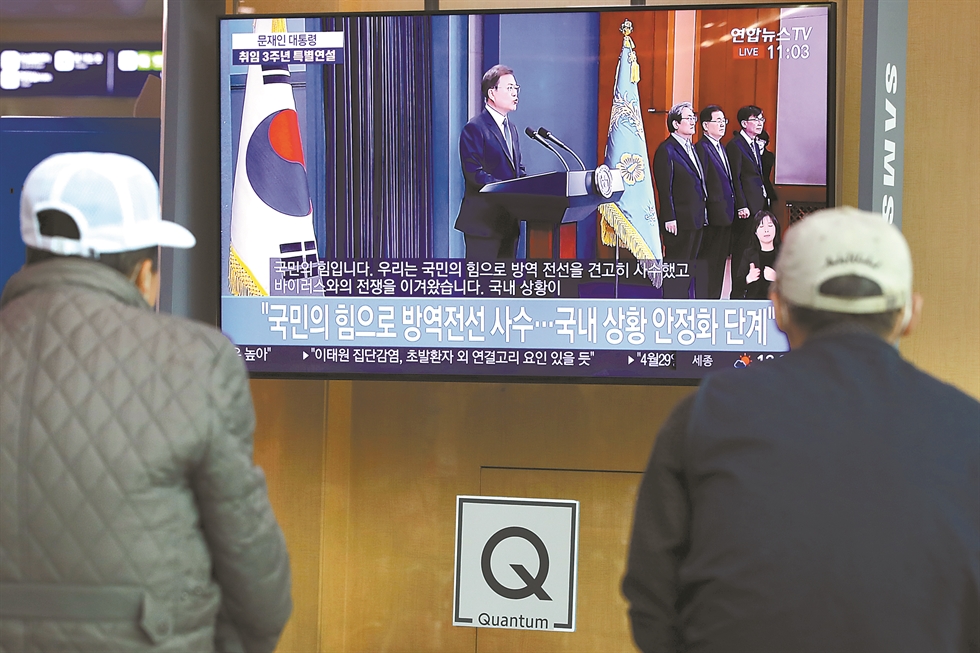
Korean ‘New Deal’
Moon also underlined the introduction of a Korean version of the New Deal as a national project to create jobs. “The large-scale job creation project will be actively pursued: Cities and industrial complexes, roads and transportation networks, and aging national infrastructure will be combined with artificial intelligence and digital technology in order to make them smart. We will harmonize the process to fully uphold the important value of not only protecting personal data but also securing a public service role for medical services and education.”
The message came as the worst of the COVID-19, which has resulted in unforeseen socio-economic changes in the last couple of months, is considered to be considerably over in Korea, with the number of infections down to stable levels and schools getting ready to receive students after weeks of online classes.
“We will use our relatively rapid stabilization of the COVID-19 outbreak and the transition to a new normal as a turning point for enhancing economic vitality,” Moon said. “We will move up the timetable for boosting consumption and recovering tourism as well as redouble our efforts to promote investment.”
The President also vowed to pay more policy attention to easing the struggles of irregular workers, who have long been excluded from social benefits such as unemployment insurance. It is the first time for the President to mention the possibility of adopting universal unemployment insurance for all employed people, which has raised concerns among the opposition and some of the Korean public about additional tax hikes.
“Through a social agreement, we will also gradually expand the eligibility for the insurance to cover all of the self-employed,” Moon said. “Expanding the employment safety net is an essential task to bolster our economy’s dynamism as well. The laws and system will be overhauled to broaden the range of eligible unemployment insurance subscribers step by step. The National Assembly’s understanding and cooperation are very important. I ask the Assembly to support this through legislation.