 |
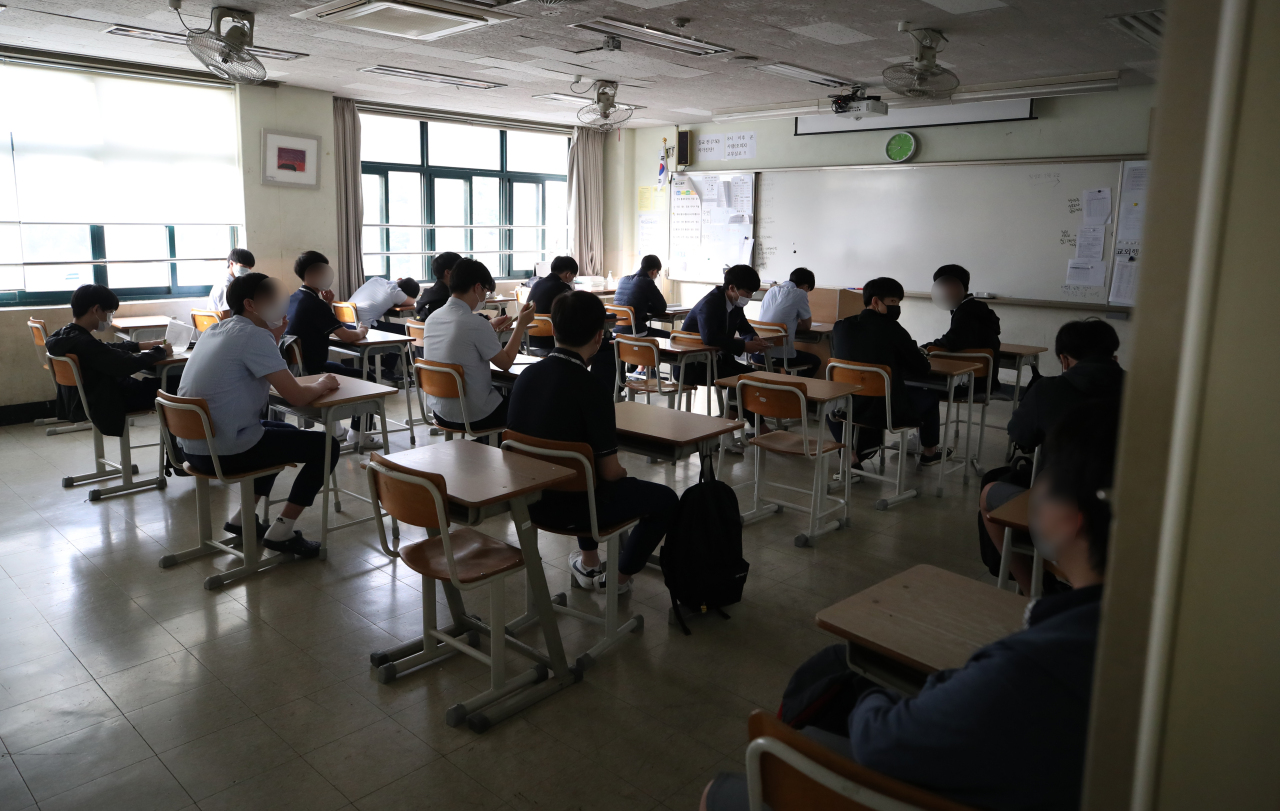
| Students at Yongsan High School in Yongsan-gu, central Seoul, prepare for class late last month on the first day in-person classes resumed for all educational institutions in the capital region consisting of Seoul, Incheon and Gyeonggi Province. (Yonhap) |
Amid the coronavirus outbreak, students, parents and teachers are rediscovering the merits of a small school.
While in-person classes have been limited to only once or twice a week at crowded schools in Seoul, Incheon and Gyeonggi Province due to persistent coronavirus threats, rural schools with fewer than 100 students in total have been running normally, except for periodic body temperature checks and required mask-wearing.
In late June, Lee Hyun-jin had her two girls transfer from an elementary school in Anyang, Gyeonggi Province, to a school on the southern island of Jeju that only has between 10 to 15 students per grade.
“Since day one, my girls have been going to school five days a week and participating in after-hour programs until as late as 4 p.m.,” she said. “It is the best thing I’ve done this year.”
The school in Anyang had a reputation for providing quality education, but was overcrowded with 27-28 students per class. “Had my kids stayed, they would have gone to school only about 12-13 times in total by now,” Lee said.
The coronavirus pandemic, or more precisely the growing discontent about prolonged distance learning, is making schools with smaller student bodies an object of envy for parents and students.
Amid this newfound interest in smaller schools, calls are growing for the government to invest in the “most fundamental” aspect of education – the optimal class size.
Proponents of smaller classes say fewer students per teacher or class will help improve the quality of teaching and make a safer and more efficient learning environment for students.
“Teachers cited over-concentrated classes as the biggest problem facing schools during this coronavirus outbreak,” the Korea Teachers & Education worker’s Union said in a statement late last month.
“We have suggested that reducing class sizes should be given top priority in order to narrow the achievement gap and expand in-person classes for students. It is the most basic prescription to solve many problems stemming from the coronavirus situation.”
Despite the country’s notorious obsession with education, its schools have traditionally been more crowded than those in other OECD member countries.
According to OECD data from 2018, the average class size in Korea was 23.1 students at elementary schools and 26.7 at middle schools, higher than the OECD averages of 21.1 and 23.3 respectively.
Korea ranked 23rd out of 30 OECD member countries with terms of the class size in elementary schools and 24th for middle schools.
The number of students per classroom is considered as one of the main standards in evaluating the provided quality of education, with smaller figures generally representing greater attention being given to each student.
President Moon Jae-in, during his election campaign in 2017, pledged to raise the country’s levels to the OCED averages within his term, which ends in May 2022.
But as of last year, there were still 60 elementary schools, 242 middle schools and 131 high schools nationwide that had more than 31 students per classroom. Some 2,984 elementary schools, 1,907 middle schools and 1,667 high schools had students between 21 and 30 per class.
Coronavirus-induced disruptions at schools have added urgency to the problem and a legislative proposal has recently been submitted to the National Assembly seeking to put a uniform cap on class size at schools nationwide.
Rep. Lee Tahney of the Democratic Party, who drafted and proposed the bill, said the legislation aims to limit the maximum number of students per class to 20. “The Education Ministry’s core initiatives such as green smart schools and online classroom projects could lose efficacy without a reduction in class sizes.”
Currently, regional educational offices have the authority to set and adjust the size of student bodies, depending on school-age demographics in their jurisdiction.
The Education Ministry, while agreeing to the fundamental idea of making class sizes smaller, remains cautious about introducing any drastic change that would require costly adjustments in school buildings and teaching staff.
“Not all schools have the same level of appeal to students and parents, and accordingly some schools draw too many students while some others do little,” a ministry official said in a phone interview.
“Setting the standard at 20 sounds all good and nice, but who’s going to pay for the cost of building new schools, persuading parents (to send their kids to a distant school if one nearby is full), devise measures to send teachers to less popular schools?”
Even if a consensus is reached on such spending and a 20-student cap is placed, the measure itself would be a short-sighted one, as the number of students is expected to naturally fall to below 20 students per class by 2025 due to declining birthrates, the official added.
According to a projection by Statistics Korea, the population of elementary school-age students is expected to shrink more than 35 percent in the next 10 years, from the current 2.65 million to 1.72 million in 2030.
At the same time, the combined number of middle and high school students is projected to drop 13.2 percent from 1.85 million to 1.6 million.
The average class size will continue to shrink, the Education Ministry projects, reaching the 20-student mark in 2025. Due to this sharp contraction in student numbers, the ministry was originally looking to slow down the hiring of new teachers.
“But with the coronavirus outbreak posing questions as to what a new learning environment should look like, we are internally debating a new direction in regards to the number of new teachers,” a ministry official said.
“As for dropping the number of students per class in hyper-concentrated areas, a lot of work is up to regional, municipal and district governments, and nothing is easy in that regard.”
By Ko Jun-tae (ko.juntae@heraldcorp.com)