By Jung Da-min
A year has passed since South Korea and the United States agreed on their defense cost-sharing for 2019. But talks for this year’s cost-sharing that were supposed to be finished before 2020 started, show no end in sight with the two sides failing to narrow their difference during the past six rounds of negotiations.
After the last round in mid-January, the next was expected to be held early February. But the specific date for the meeting has yet to be decided, while the nation has been focusing more on efforts to battle the spread of the new coronavirus since last month.
In late January, the United States Forces Korea (USFK) warned of a potential administrative furlough of Korean staff that could occur starting April if the allies fail to conclude the 11th Special Measures Agreement for this year’s cost sharing. An official from the USFK said the possible furlough would be due to a loophole in this year’s budget from the South Korean side, which accounts for about 75 percent of the salaries of Korean staff.
The prospect for a compromise looks dim at the moment, however, as Foreign Minister Kang Kyung-wha said at a press briefing last Thursday, the government cannot predict when and how the talks will be concluded. Kang said the two sides have noted the gap between them is “still wide.”
Amid growing fears from the coronavirus outbreak, ranking diplomatic officials from South Korea, including Kang, have been busy arranging charter flights to evacuate Koreans from China’s Hubei Province, and contemplating whether an additional entry ban on foreign travelers from China would affect Seoul-Beijing ties and Chinese President Xi Jinping’s planned visit to Korea.
Although the epidemic is a serious issue, the defense cost talks are also an important matter with an April deadline.
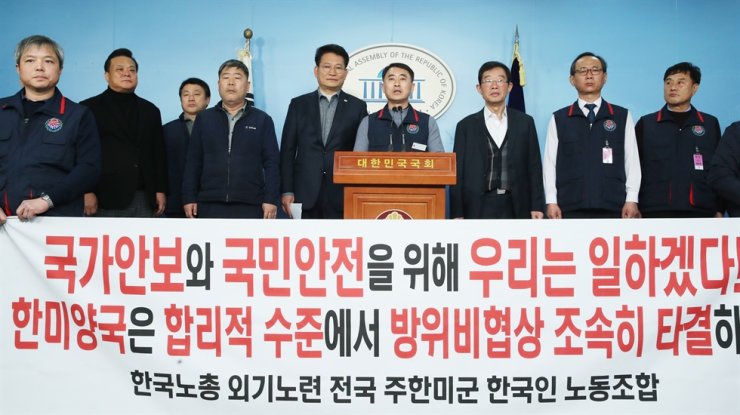
The USFK Korean Union members held a press briefing at the National Assembly, Thursday, to condemn both sides for “repeatedly taking Korean staff hostage” in negotiations and call for a solution to be found by improving related systems. They also said they would continue to work for national security even though they would not get paid starting April, urging the two allies to solve the issue as soon as possible.
Political watchers are raising concerns that the delay in negotiations is raising diplomatic and military risks on the Korean Peninsula while sending the wrong message to neighboring China and North Korea.
Both parties of the South Korea-U.S. alliance need to show their firm commitment to each other, and the first step should be solving the defense cost-sharing issue.