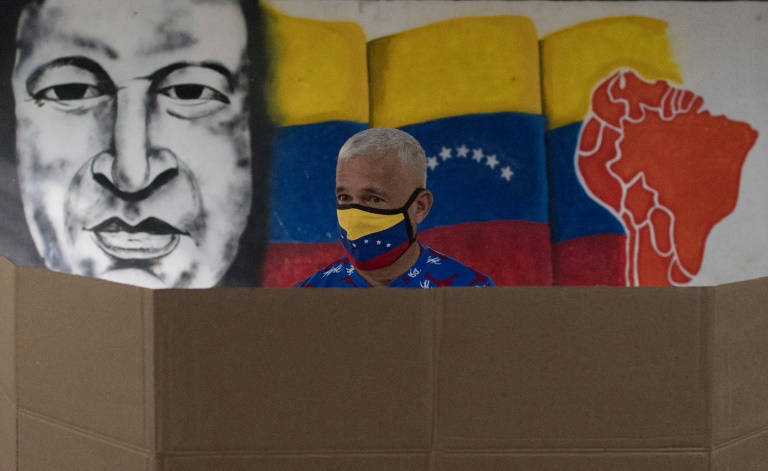
CARACAS – Venezuelan opposition parties participated in elections Sunday for the first time since 2017, voting for governors and mayors in a litmus test for President Nicolas Maduro's government amid international sanctions and economic crisis.
With European Union observers returning to the country after a 15-year absence, long queues of voters formed early at polling booths in the capital Caracas — a very different picture from elections for president in 2018 and for parliament two years later that were boycotted by the opposition.
“I feel that this time people are determined to vote,” said Jose Rafael Hernandez, a 58-year-old opposition supporter casting his ballot in the capital, Caracas.
“I would like all of us to vote, even if it is a form of protest,” added Daniel Rey, a 25-year-old doctor from San Cristobal near the Colombian border.
“It is the best way to show that we want change for the benefit of the country.”
Leftist Maduro, whose deeply controversial presidency has seen the South American nation targeted by punishing economic sanctions, has sought a relaxation of the punitive measures through careful shows of goodwill and democratic intent.
With hundreds of millions of dollars of its funds frozen abroad, Venezuela wants to be able to sell its petroleum more easily — the United States is historically its biggest customer — and to end limits on imports.
The government has made a calculated series of concessions, opening negotiations with the opposition, and inviting election observers from the EU, the United Nations and the US-based Carter Center to witness Sunday’s vote.
The opposition, which for the past three years had boycotted elections they said were neither free nor fair, agreed to take part after receiving assurances from the government.
Opposition leaders hope to raise their profile through participation, and to gain support ahead of presidential elections set for 2024.
Some 21 million of Venezuela’s 30 million people are eligible to vote Sunday for 23 state governors, 335 mayors as well as state and municipal councils.
But there seems little doubt about the outcome, expected in the early morning hours of Monday — experts predict the Chavist movement that Maduro has led since the death of President Hugo Chavez in 2013 should easily prevail over a divided opposition.
– ‘In peace’ –
Polling stations closed at 6:00 pm local time (2200 GMT), but those already in line were allowed to stay until they had cast their ballot — sparking claims of fraud from the opposition.
“Maduro and his party ordered the CNE (electoral body) not to close the polling stations when there were no voters… They are going to put votes that do not exist,” Tweeted opposition figure Henrique Capriles, who has twice come second in presidential elections.
The head of the 130-member EU observer mission, Isabel Santos, said during the day that the election was proceeding “calmly,” and defense minister Vladimir Padrino told public television the election had taken place “in peace”.
One person was shot dead near a voting center in the country’s east, but the authorities said it was not related to the election.
On the eve of the vote, Maduro had warned that the EU had no authority to give a “verdict” on the process in a country that is prickly about its “sovereignty,” often accusing the United States of interventionism.
“All international escorts must respect the laws of Venezuela, and must strictly respect the regulations of the electoral power that invited them,” the president said.
The United States is among dozens of countries which do not recognize Maduro’s presidency after the impugned elections of 2018 that opposition leader Juan Guaido claimed to have won.
Guaido has said the opposition must “unify the struggle” but indicated he would not vote as “it is certain that Maduro is, and will continue to be, illegitimate.”
Venezuela, a once-rich oil producer, is battling its eighth year of recession and hyperinflation that reached nearly 3,000 percent in 2020 and more than 9,500 percent the year before, according to central bank figures.
Three in four Venezuelans live in extreme poverty, according to a recent study, with the economic crisis made worse by US sanctions and the coronavirus pandemic.
Millions have left the country in recent years to try their luck elsewhere.